Why Question Restaurant Coaches? What Real Operators Actually Do
Running an independent restaurant is hard enough without someone who has never closed a shift telling you how your business should operate.
When a so-called restaurant coach has cleaner shoes than your hosts and softer hands than your prep cook, you should have questions.
You are already juggling staff, guests, vendors, repairs, scheduling, food costs, payroll, and a stack of bills that never seems to get smaller. You do not need more theory. You need practical moves that work inside your restaurant this week.
I have spent more than two decades in this business, from bussing tables and serving guests to owning and operating restaurants. I have burned my hands on hot plates, worked doubles, covered no-shows, and stared at the bank balance on a Monday morning wondering how the restaurant could be full while the account was still light.
That experience changes how I look at profitability, systems, training, and marketing.
Here is how real operators think and how to spot the people who actually understand the work.
Stop Paying Restaurant Coaches Who Have Never Closed
Everywhere you look, someone is selling a restaurant program.
The presentation looks sharp. The promises sound good. There is usually plenty of talk about leadership, mindset, culture, and scaling.
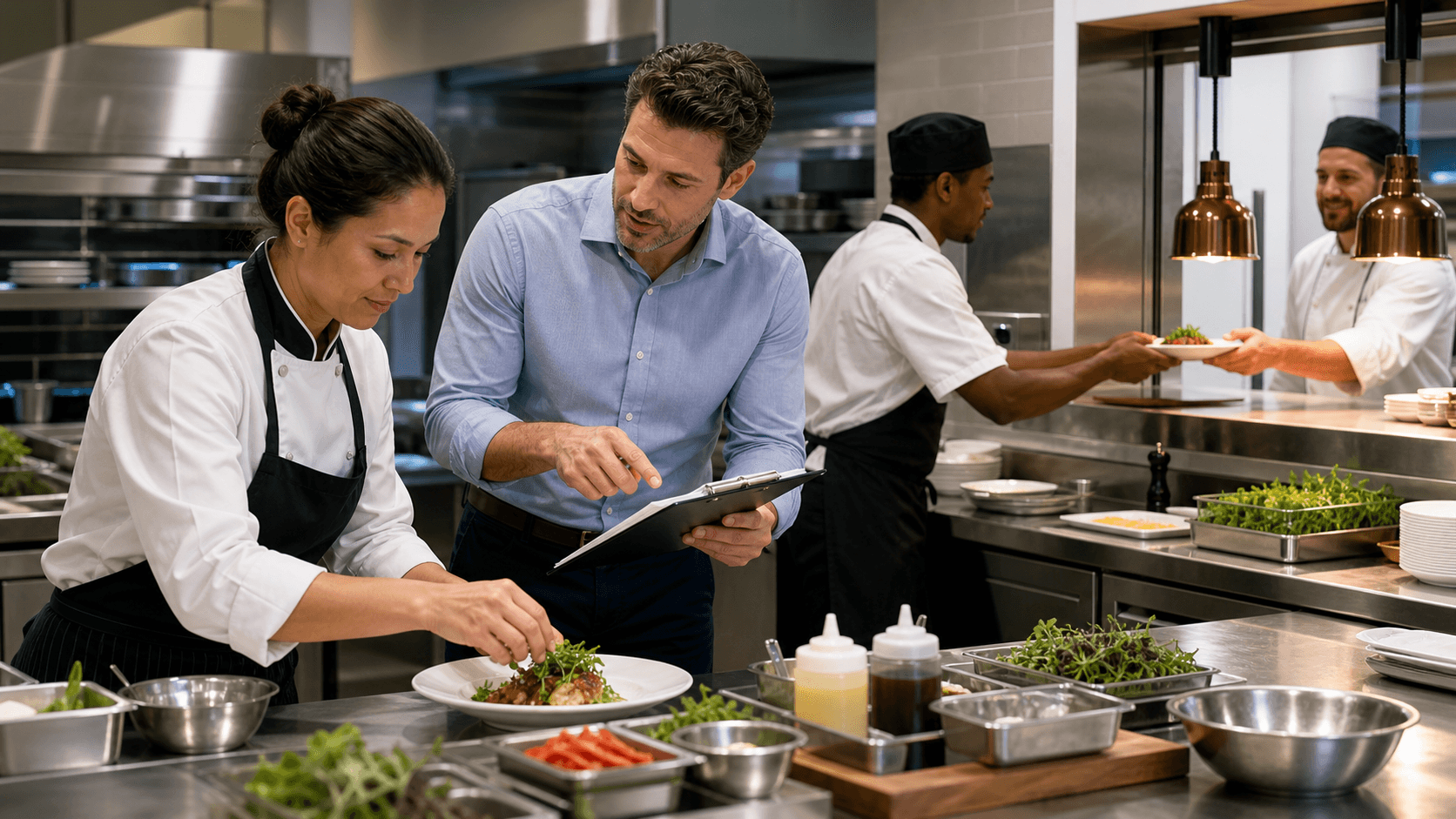
Then you find out they have never run a slammed patio in July, managed a short-staffed brunch, covered a station, completed inventory, or locked the doors after a brutal close.
Peak summer hits, and you are living in a completely different world:
- Patio full, inside half full• Line short two people• Food costs creeping up• Guests happy, bank account not so much
This is where real experience matters.
A coach who has never worked a close does not fully understand the pressure of:
- A grill cook no-showing right before a 30-top• A keg blowing in the middle of a packed game night• A walk-in surprise that throws off prep for the next three days• A dishwasher walking out while the dining room is still filling• A supplier shorting the product your feature menu depends on
Real operators think in ticket times, plate cost, staffing levels, prep capacity, and team energy.
We think in shifts, not slides.
That is the lens that fixes margins and reduces chaos. It is not about making the owner feel inspired for two days. It is about making the restaurant operate better when the pressure is on.
How Real Operators Actually Fix Profit Margins
Profit is not won in a workshop.
It is won through boring, repeatable daily details.
Most busy-but-broke restaurants look similar from the outside. The dining room is full. The staff is moving. Tickets are printing. Sales appear healthy.
Meanwhile, the owner is still working too many hours and not paying themselves properly.
Common signs include:
- Legacy menu items no one wants to remove because "the regulars love them," even though they destroy food cost• No one checking plate cost against selling price• Pricing based on what feels fair instead of what the business requires• An item mix that pushes low-margin sellers while profitable items barely move• Portion standards that disappear the moment the restaurant gets busy• Too much product being prepped "just in case"
Here is how an operator attacks it:
- Start with a brutally honest P&L, even when the numbers hurt.
- Pull the POS data and re-cost the highest-volume items first.
- Identify the items that are popular, profitable, both, or neither.
- Remove or adjust the losers that eat margin, labour, and storage space.
- Tighten prep lists so the team stops overproducing out of habit.
- Build a weekly numbers rhythm that the owner and managers will actually maintain.
That rhythm might be as simple as:
- One hour a week reviewing food, labour, sales, and top sellers• One focused menu adjustment every few weeks• One conversation with the kitchen about a portioning problem• One clear target the leadership team is responsible for improving
The usual coaching advice is to increase average cheque size or teach the servers to upsell more wine.
Those ideas are not necessarily wrong, but without understanding your line, vendor pricing, neighbourhood, guest habits, menu mix, and service model, they are just surface-level advice.
Operators start with your plates, your labour, your covers, and your actual numbers.
Not a quote on a slide.
Systems That Survive a Saturday Night Rush
The word "systems" gets thrown around constantly.
In a real restaurant, systems are simply repeatable habits that stop the operation from falling apart when things get ugly.
Think:
- Opening and closing routines that do not depend on one superstar employee• Line checks and pars that still hold when a delivery arrives late• Order guides that any trained supervisor can follow• Training standards that still work when you are three people short• Clear accountability when something gets missed
There is a major difference between binder-systems and operator-systems.
Binder-systems live inside a beautiful manual that nobody opens after the first week.
Operator-systems live where the work happens:
- Two-page checklists laminated at expo• Clear station setup standards• Prep sheets that reflect actual sales• Simple rules the team can remember during a rush• Manager routines that get completed without the owner chasing them
I design around the weakest day, not the best one.
Plan for:
- New staff on the floor• Missing prep because of a delivery issue• A manager calling in sick• A random 30-top walking in during your usual quiet period• A rush hitting 45 minutes earlier than expected
If your process collapses under that load, it is not a system.
It is a hope.
This is where theory-heavy restaurant coaches often get it wrong. They add more forms, more steps, more meetings, and more apps.
Operators strip the process down.
The system has to fit naturally into pre-shifts, ordering, prep, scheduling, line setup, and closing procedures. It cannot become another job that nobody has time to complete.
Marketing That Actually Brings Paying Guests
A lot of restaurant marketing delivers pretty content and not much else.
You get:
- Generic social media calendars• Canned captions that sound nothing like the restaurant• Photos that look polished but never turn into bookings• Vanity reports filled with impressions, reach, and engagement• No clear connection between the marketing and actual sales
Real operators think about paying guests, not just likes.
That starts with understanding the neighbourhood and the business in front of us.
I look at:
- Local partnerships that make sense for the concept• Event nights the kitchen and bar can actually execute• Offers that protect margin while still giving the guest a reason to visit• Simple email and SMS list-building so the restaurant is not fully dependent on an algorithm• Google visibility, reviews, and the information guests see before making a decision
I also think in seasons.
Running a restaurant in a Canadian city means summer and winter can feel like two completely different businesses.
Operator-style planning might include:
- Summer patio pushes supported by a tighter menu the line can execute in the heat• Quiet-season offers that fill slower nights without discounting the entire business• Early holiday and group-booking campaigns instead of panicking at the last minute• Catering pushes when dine-in traffic naturally slows• Staffing and menu plans that reflect seasonal sales patterns
Before talking about driving more traffic, I want to know how much food your kitchen can push, how many seats you can turn without crushing service, and where the team is already stretched.
Marketing that ignores operational capacity is dangerous.
It creates long ticket times, poor execution, exhausted employees, unhappy guests, and negative reviews.
More guests are only valuable when your restaurant is ready to serve them properly.
Real Owner Outcomes and How to Spot a Real Operator
When owners receive real operator support, the same patterns start to appear.
You do not add more ideas.
You cut the noise and focus on the few moves that will create the largest impact:
- Menu changes tied to plate cost and POS data• Labour scheduling tied to actual demand instead of hope• Inventory discipline so cash is not sitting unnecessarily in the walk-in• Clear manager accountability• One or two marketing channels executed consistently• Weekly numbers the leadership team understands and acts on
Most programs promising a total transformation in a few weeks are heavy on mindset and light on actual restaurant work.
They rarely spend a full night watching service.
They do not see where the team hesitates, where tickets stall, where products get wasted, where communication breaks down, or where money quietly leaks out of the operation.
So how do you spot someone who has actually done it?
Ask questions that only operators can answer:
- What stations have you worked, and for how long?• How many opens and closes have you done in a row?• What should labour look like in July compared with January in our climate?• What would you do if the grill cook no-showed on a packed Saturday?• How would you attack a three-point increase in food cost from last month?• What reports would you pull from the POS first?• What would you look for during a Friday night service?
Watch for warning signs of a pure theory coach:
- Lots of frameworks and mindset shifts• No meaningful conversation about ticket times, plate cost, prep, or line layout• No interest in the walk-in, prep lists, invoices, scheduling, or vendor relationships• Recommendations before they have reviewed the numbers• More concern about presentation than execution
It is not rude to ask hard questions.
You are giving someone access to your business, your numbers, your team, and potentially your livelihood.
If they cannot handle real operator talk across the table, they will not survive one rough week inside your restaurant.
If You Want Operator Eyes on Your Restaurant
If you are looking for slide decks, recycled frameworks, and hype, I am not your person.
If you want someone who has run the floor, worked the closes, covered the stations, managed teams, reviewed the numbers, and fixed margins inside a real independent restaurant, that is the work I do.
I am not coming into your business to tell you how smart I am.
I am there to provide a second set of trained operator eyes.
Sometimes the owner is simply too close to the operation to see the leak clearly. You are solving problems, covering shifts, answering staff questions, dealing with guests, and trying to keep the business moving.
My job is to slow the picture down, identify what is actually happening, and help you prioritize the changes that matter most.
If you want a straight assessment of your menu, labour, systems, training, and marketing, reach out and book a discovery call.
We will talk through your numbers, your neighbourhood, your capacity, and the areas causing the most pressure.
The goal is not to bury you in recommendations.
The goal is to show you where the money is leaking, what needs to be addressed first, and what practical moves you can make over the next 30 and 90 days.
Work With A Professional Restaurant Coach To Reach Your Next Level
If you are ready to sharpen your systems and profitability, I work with independent restaurant owners who want practical, data-backed improvements, not generic advice.
As a professional restaurant coach, I bring an owner-operator perspective to the table. That means looking closely at your numbers, menu, labour, training, systems, guest experience, and marketing before recommending a path forward.
This is not about rebuilding your entire restaurant overnight.
It is about identifying the right moves, putting workable systems in place, and helping you build a stronger and more profitable operation.
Tell me about your restaurant, the challenges you are facing, and what you want the business to look like next.
Then we can determine the right path forward.