Stop Chasing More Covers. Improve the Revenue You Already Have.
The dining room is full. There is a wait at the door. The printers are screaming, the patio is packed, and everyone on the team is running.
Then you look at the P&L and wonder where the money went.
I have lived that night more times than I can count. I have worked the line, run the floor, managed the pass, and signed the cheques at the end of the month.
More covers can feel like growth, but volume does not automatically create profit. In many independent restaurants, it simply multiplies labour, food costs, mistakes, waste, and exhaustion.
That is not always a sales problem.
It is often a revenue quality problem.
Revenue quality comes down to three things:
- Guests spending more without feeling pressured
- A stronger mix of profitable food and beverage sales
- Guests returning because the experience felt worth it
Low-quality volume looks different. It comes from discount-driven traffic, low-margin items, rushed service, overwhelmed employees, and guests who never come back.
Before spending more money trying to bring additional people through the door, look closely at how revenue is being generated from the guests already sitting in your restaurant.
Four areas usually reveal the biggest opportunities:
- Menu structure
- Service choreography
- Reservation pacing
- Guest recovery
These are not theories for a boardroom. They are operating systems that need to hold up during a full Saturday-night service.
Engineer a Menu That Makes Profitable Choices Easier
Many independent restaurant menus were built gradually rather than intentionally.
An old favourite stays because regulars know it. A new feature becomes permanent. Another item gets added because a competitor sells something similar. Before long, the menu is carrying too many ingredients, too much prep, and too many dishes that barely contribute to the bottom line.
Guests become overwhelmed. The kitchen becomes complicated. Profitable items get buried beside dishes that generate plenty of work but very little return.
Menu psychology is not about tricking anyone.
It is about making the menu easier to understand while guiding guests toward choices that are good for their experience and sustainable for the restaurant.
Start with three areas.
Give Profitable Items Better Placement
Your strongest items should not be hiding in the middle of a crowded section.
Look for dishes that combine:
- Strong contribution margin
- Consistent guest satisfaction
- Reliable execution
- Reasonable prep requirements
- Ingredients that work across the menu
Place those items where guests naturally look first. Use clear descriptions and simple visual emphasis. You do not need boxes, stars, photographs, and five different typefaces. You need a clear hierarchy.
Stop giving your cheapest or least profitable dishes the most valuable space simply because they have been on the menu the longest.
Build Logical Price Ladders
Guests should be able to see a natural progression between options.
That might mean moving from:
- A core entrée
- To a slightly more premium version
- To a shareable or upgraded experience
The increases should feel reasonable. Random price jumps create hesitation. A well-built ladder gives guests options while making the next level feel accessible.
Remove Complexity and Build Better Add-Ons
Every menu item comes with an operational cost.
It requires ingredients, storage, prep, training, POS programming, quality control, and space in the kitchen team's memory.
If an item sells poorly, generates weak margins, or repeatedly causes execution problems, nostalgia may not be a strong enough reason to keep it.
Trim the items that create work without creating value.
Then build add-ons that feel like natural improvements to the meal:
- Premium sides
- Shareable starters
- Beverage pairings
- Table desserts
- Protein upgrades
- Seasonal features
These should feel like hospitality, not a transaction.
Seasonality can also improve both margin and execution. A summer menu, for example, might include lighter dishes, cold preparation, shorter cook times, and features that reduce pressure on the grill or sauté station.
Menu work should never begin with fonts and photography.
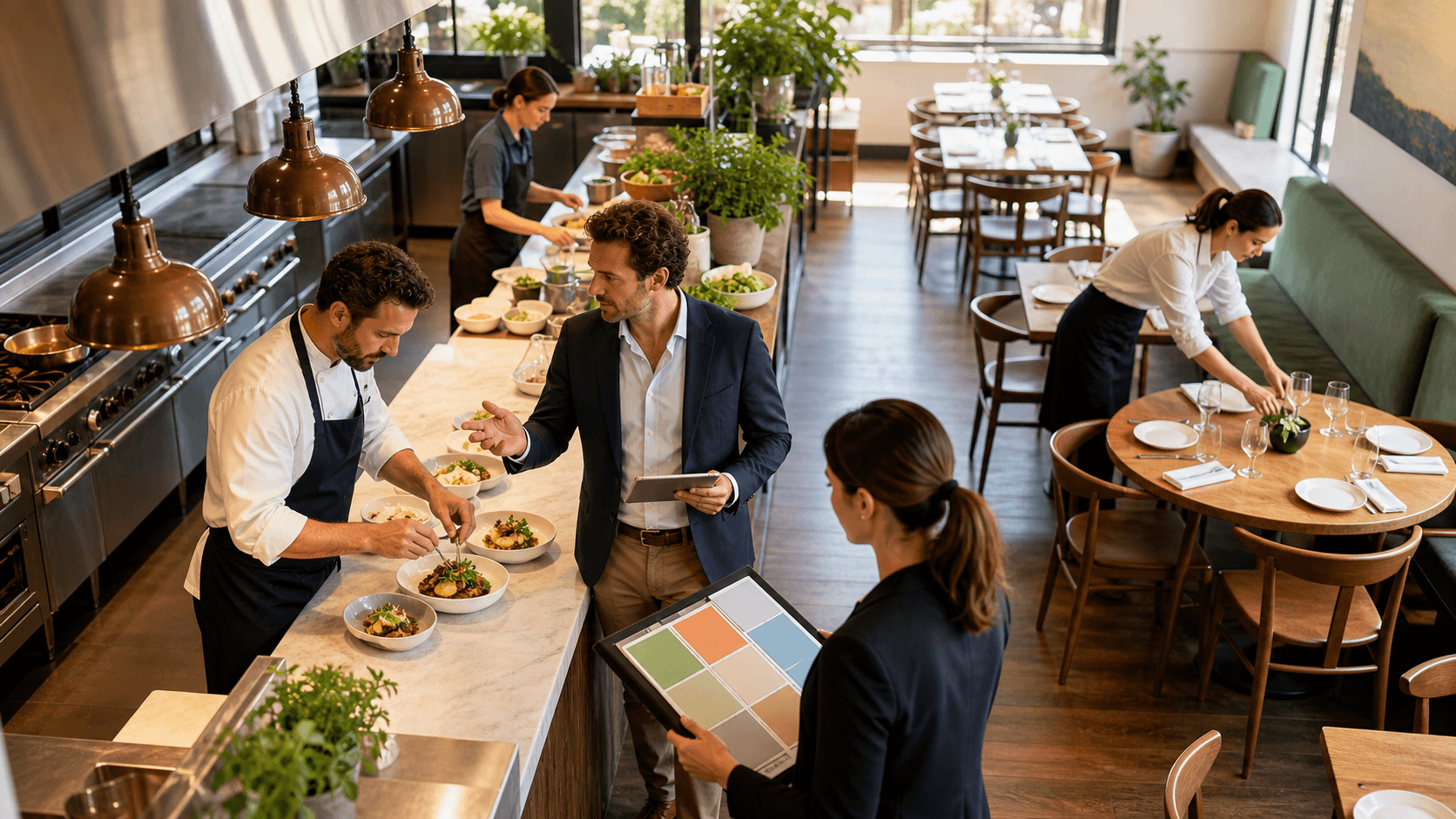
It begins with recipe costing, POS sales mix, prep requirements, ticket times, and a walk through the kitchen during actual service.
A beautiful menu is useless if the kitchen cannot execute it when the room is full.
Replace Random Upselling With Service Choreography
Most restaurant owners believe their experienced servers already know how to sell.
Some do.
The problem is that sales performance is usually left to individual confidence, personality, and memory. That creates inconsistency from server to server and shift to shift.
When the restaurant gets busy, those inconsistencies become even more obvious. Features are forgotten. Drink refills come too late. Desserts are mentioned after the guests have already asked for the bill.
Server choreography creates a repeatable structure without making the interaction sound robotic.
Every employee can use their own personality, but the important moments should happen consistently.
The First 90 Seconds
The opening interaction sets the tone.
The guest should be greeted quickly, offered a beverage, and given one useful recommendation.
Not five features.
Not a rushed list of everything the kitchen needs to sell.
One clear suggestion that fits the menu strategy and helps the guest make a decision.
For example:
"Our featured starter tonight is the whipped ricotta. It is designed for the table and has been one of the most popular ways to begin."
That sounds more confident and useful than:
"Do you want any appetizers?"
Mid-Meal Checkpoints
Selling opportunities should be built into the natural flow of service.
That includes:
- Offering a second beverage before the first one is empty
- Suggesting a shareable side while the mains are being finalized
- Checking satisfaction early enough to correct a problem
- Introducing dessert before guests mentally close the meal
- Offering coffee or an after-dinner drink at the right moment
Timing matters as much as language.
An offer made too late is not an offer. It is an interruption.
Confident Language
Guests do not need pressure. They need useful guidance.
Phrases such as these can make decisions easier:
- "Most tables begin with..."
- "That pairs well with..."
- "If you enjoy X, I would recommend Y."
- "The portion works well for sharing."
- "We only make a limited amount of that feature."
The goal is not to turn servers into salespeople. The goal is to help them become more confident hosts.
Training and Accountability
Service choreography only works when it is reinforced.
Keep the process simple:
- Focus each pre-shift meeting on one item and one service behaviour
- Have managers observe real table interactions
- Track beverage, appetizer, side, and dessert attachment rates
- Coach employees individually instead of embarrassing them publicly
- Share examples of language that is working
The system also needs to respect the kitchen.
There is no value in aggressively selling a starter the kitchen cannot execute or pushing a cocktail that buries an already overwhelmed bar.
The best service systems connect the floor, the kitchen, and the guest experience.
Control Demand Before It Reaches the Kitchen
Many restaurants treat reservations like a digital guestbook.
People choose a time, the system accepts the booking, and the team deals with the consequences later.
That is how a restaurant ends up with a packed dining room at 7:00, empty tables at 8:30, angry guests at the door, and a kitchen that receives more orders than it can realistically execute.
The door should work with the kitchen, not against it.
Set Realistic Reservation Limits
Determine how many guests the restaurant can seat within each 15-minute period without overwhelming the kitchen.
Base that number on actual performance:
- Available equipment
- Kitchen staffing
- Average ticket times
- Menu complexity
- Table mix
- Historical order volume
Do not build reservation capacity around the best service the restaurant has ever produced.
Build it around what the team can execute consistently.
Understand the Table Mix
A restaurant with too many four-tops may struggle to accommodate couples efficiently. A room filled entirely through reservations may have no flexibility for walk-ins. A patio may create additional seating without adding meaningful kitchen capacity.
Review:
- The number of two-tops, four-tops, and larger tables
- Average dining time by party size
- Which tables can be combined
- How many tables should remain available for walk-ins
- When different sections typically turn
A full reservation book does not always represent an efficient seating plan.
Communicate Time Expectations Properly
During peak periods, some restaurants need defined seating windows.
Those expectations should be communicated clearly and warmly when the reservation is made, not introduced near the end of the meal when the next group is already standing at the door.
Good pacing produces more than shorter ticket times.
It creates:
- Fewer kitchen mistakes
- Fewer guest complaints
- Better food quality
- More confident service
- More accurate table turns
- Lower recovery costs
The objective is not to squeeze more people into the room.
It is to control the flow so the restaurant can deliver what it has already promised.
Build a Guest-Recovery System Before Something Goes Wrong
Every restaurant eventually misses.
A steak is overcooked. A ticket is lost. A server forgets an item. The kitchen runs out of a feature. The quoted wait time turns out to be unrealistic.
The difference between a frustrated guest and a lost guest often comes down to what happens immediately after the mistake.
Guest recovery should not be improvised while everyone is emotional.
It should be a simple operating system.
Give the Front Line Clear Authority
Servers and supervisors should know what they can do without waiting for a manager.
That might include permission to:
- Replace an item immediately
- Send a dessert
- Remove a beverage
- Offer coffee
- Provide a defined bounce-back offer
There should also be a clear point where a manager must become involved.
Employees need enough authority to act quickly, but the boundaries need to be understood.
Create a Recovery Menu
Do not leave every resolution to personal judgment.
Pre-determine appropriate responses for common problems.
A delayed appetizer does not require the same recovery as an incorrect meal for a guest with an allergy. A minor service delay does not need the same response as a completely failed experience.
A recovery menu helps the team respond consistently while protecting margin.
Track the Cause, Not Just the Comp
A comp report should not be treated only as a financial record.
It is an operational report.
Every meaningful recovery should answer:
- What happened?
- Where did the breakdown begin?
- Was this an isolated mistake or a recurring pattern?
- Does a process, recipe, menu description, staffing decision, or training issue need to change?
If the same dish is repeatedly being removed from bills, the problem is probably not the guests.
If quoted wait times are consistently wrong, the host team may need better information.
If one station is responsible for most delays, the menu or kitchen setup may be exceeding its capacity.
Good recovery protects the relationship with the guest.
Good follow-up protects the business from repeating the same mistake.
Stop Running Harder and Start Improving the Machine
More covers will not rescue a restaurant with weak systems.
They will expose those weaknesses faster.
Before investing more money into advertising, promotions, discounts, or delivery channels, examine the revenue already moving through the business.
Ask four questions:
Menu
Are the most profitable and executable items easy to find, understand, and order?
Floor
Does the service team follow a consistent sequence that improves the experience and supports the average check?
Door
Are reservations and walk-ins paced around the restaurant's actual capacity?
Recovery
Can the team correct problems quickly, consistently, and without creating another problem?
Restaurant owners are often too close to the operation to see every leak clearly.
That is not a criticism. When you are handling staffing, suppliers, guest complaints, scheduling, repairs, payroll, and a Saturday-night rush, it becomes difficult to step back and study the entire machine.
Sometimes what an owner needs is not another consultant with a template.
It is a second set of trained operator eyes.
Someone who can look at the sales mix, walk the floor, watch the kitchen, and identify where the operation is working harder than it needs to.
Improving revenue quality does not always require a complete reinvention.
It may begin with removing three menu items, changing reservation limits, tightening one step of service, or giving supervisors clearer recovery authority.
Small operating changes, applied consistently, can improve the guest experience, reduce pressure on the team, and create more profit from the demand you already have.
That is a healthier form of growth than simply putting more bodies in seats.