Restaurant Workflow Optimization: Your Floor Is Not Chaotic Because of Your People
How many steps does it take one of your servers to ring in a single order?
Not the number you think. The real one. Walk it yourself on a Friday at seven.
Most of the time the answer is uncomfortable, and it has nothing to do with who is on the schedule. Restaurant workflow optimization is not a consulting phrase. It is just the honest count of how far product, people, and plates have to travel to get from your door to your guest. When that count is low, the room feels calm even when you are buried. When it is high, every service feels like a slow crash you are trying to steer out of.
Late summer is when the cracks show. The patio is half full, the team is tired, you have newer people on the floor, and fall and holiday volume is already on the calendar. That is exactly when sloppy flow starts costing real money. Tickets drag. Food sits in the window. Labour creeps because everyone is moving and nobody is finishing.
There is a wide gap between optimizing on a spreadsheet and actually pulling two minutes off a ticket on a slammed Saturday. Cutting two points of labour is easy in a budget meeting. Doing it without gutting service is the whole job.
Why the Room Feels Edgy Even on a Slow Tuesday
If your floor feels tense on a quiet night, that is not a people problem. It is usually a workflow problem wearing a staff drama mask.
The quiet versions look like this.
→ Sections built around the floor plan instead of the sightlines → A weak handoff between bar, floor, and kitchen, so drinks and food are never in sync → No shared language on ticket times, cuts, or sidework → One person acting as the unofficial traffic cop for the entire room
This kind of thing rarely blows up. It leaks. It shows up as comps to smooth over slow tickets, walkouts after long waits, and side comments in the staff chat that you hear about second hand. Then you start believing you hired wrong, or that another round of training will fix it. It will not. The system is asking too much of everyone in it.
The fix is usually smaller than you expect. Move a POS terminal so servers stop doing laps. Build a real landing zone for runners so plates are not touched twice. Stock cutlery and side plates where service actually happens instead of wherever they landed the week you opened.
Same hours on the schedule. Less time burned in hallways.
Every Workflow Question Is the Same Question: How Many Steps
Front of house and back of house need different plans. They are chasing the same number.
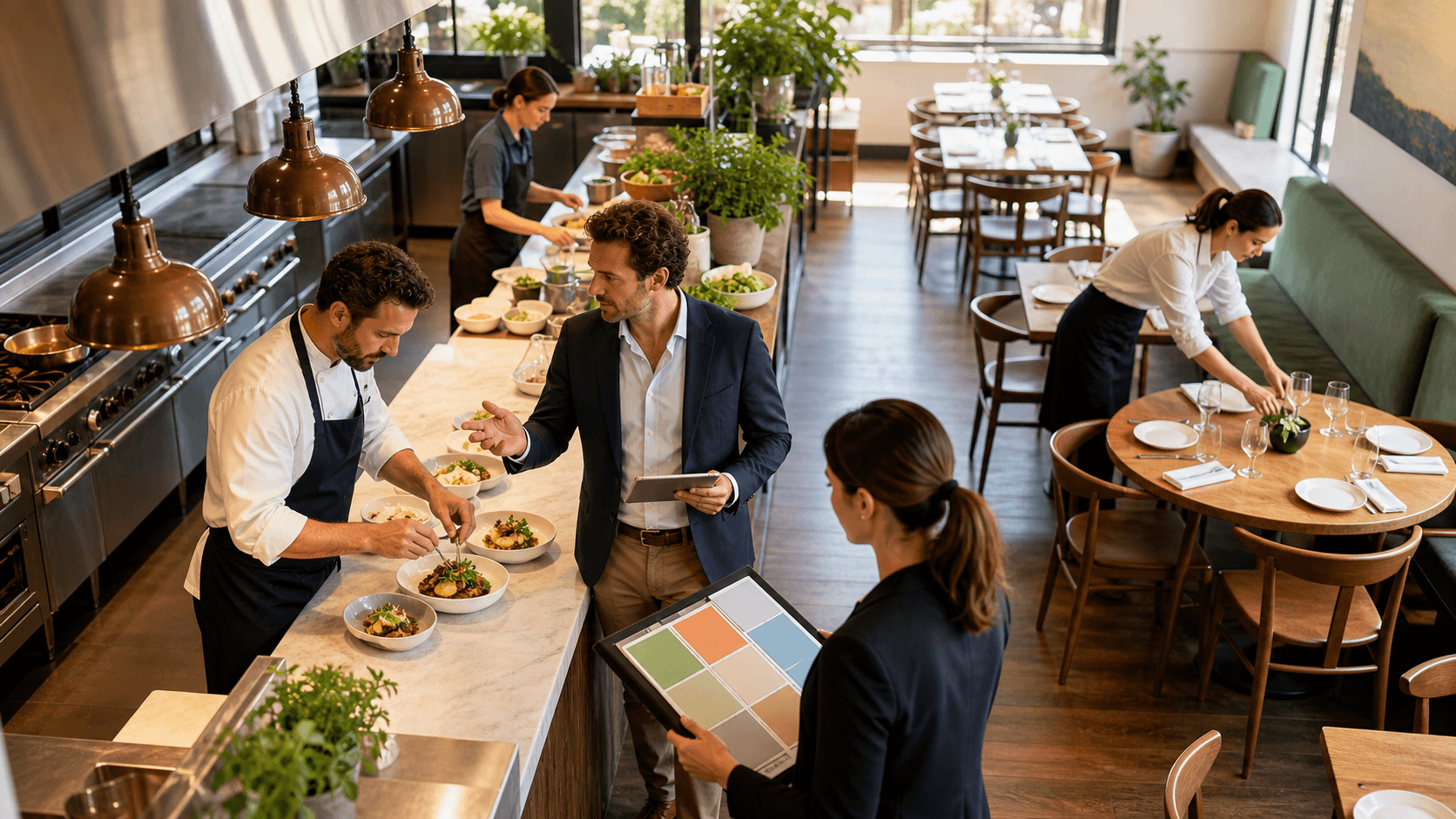
On the floor, I am looking at section design against sightlines and server capacity, a clear order-taking sequence so nobody is left hanging, batching so refills and checks happen on one pass, and pre-bussing rules that flip tables without anyone nagging.
The target is windshield time. All those empty walks between the table, the bar, and the terminal. Nobody puts it on a P&L, but it is the single most expensive thing happening in your dining room. Cut it and ticket times shrink on their own, without anyone being told to hurry.
The line works the same way. Stations set so the eighty percent of items that actually sell sit in the easiest reach. Prep lists tied to real sales patterns instead of what you hope will move. Par levels that keep the line stocked without burying you in waste. A layout built around your top movers, not the dish that goes out twice a week.
When the line runs clean, you get fewer refires, fewer remakes, and plates hitting the pass in a tighter window. That shows up as more turns, lower labour per cover, and a food cost that stops yo-yoing month to month.
None of that requires new software. It requires standing in the room during service and watching where hands reach and where bodies stop.
Systems That Do Not Feel Like a Binder on a Shelf
Independents flinch at the word systems, and fair enough. Nobody wants a manual that only comes out when the health inspector walks in.
I mean the smallest set of habits that keep the place consistent on a grey Tuesday in November and during holiday party season. Short pre-shift briefs instead of speeches. Opening and closing lists that fit on one page and match how the shift actually runs. Prep sheets tied to sales. One standard per task instead of three right ways depending on who you ask.
Build them with your team, not for them. Pull in your strongest server, the cook everyone trusts, the bartender who holds the bar together. When they shape how the work gets done, it becomes our way of running the room. Hand it down from an office and it becomes a rulebook people work around.
Heading into Q4, when your team is tired and turnover ticks up, this is what lets you plug a new person into the flow without grinding everyone else down.
Only Market What Your Line Can Nail
Marketing is great right up until it breaks your service.
I have watched operators chase reach while the line is already in the weeds, then wonder why a packed room did not show up in the bank account. Predictable, profitable traffic your current kitchen and floor can execute beats a busy night you cannot deliver.
That means promoting the items your line pushes out fast and clean. Pointing offers at slow shoulder nights instead of stacking already heavy weekends. Running promos simple enough that a server can explain them in one sentence without checking a sheet.
This is also where third-party delivery deserves a hard look, because it is the highest-volume workflow most operators never audit. I pulled my own Skip and Uber reports. Skip came in at 26.8 percent true commission against a contract that said 20. Uber landed at 19.8. That is not a marketing channel. That is a workflow decision with a price tag, and most operators have never checked what theirs actually costs.
What Actually Changes
The numbers move. Turns go up, comps go down, labour holds when sales spike.
The part operators talk about more quietly is the other change. Going from "if I leave for a weekend something will catch fire" to "the team can run this without me hovering" is a different way to live. Fewer hero shifts where two people save the night. Less burnout. A room that feels stable even when the patio is closing and parties are stacking.
Tight workflow is not a project you bolt on. It is the base everything else sits on top of. Your standards, your training, your marketing, your margin. All of it is resting on how far people have to walk.
And this is not a restaurant problem. A salon, a trades shop, a clinic, any local business with a team and a rush is asking the same question. How many steps does it take to deliver the thing you sell.
Count them. Then start cutting.
Run your business. Don't let your business run you.